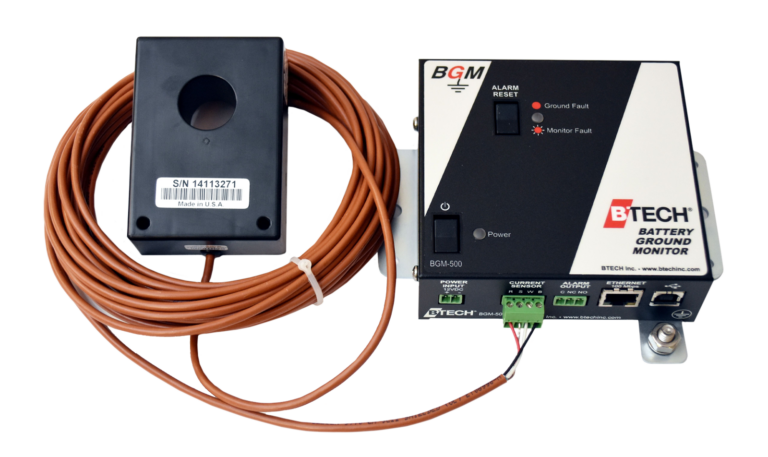
The BTECH BGM-500 is a battery ground fault monitor. It measures the small current that leaks from a battery cabinet or rack to earth ground and sends an alarm when that current passes a threshold you set, so a developing ground fault gets found before it hurts someone or damages the battery room.
On a substation DC system, an unintended ground is easy to miss. The battery looks fine and the bank voltage reads normal, but leaking electrolyte can corrode metal and short a cell to its rack or cabinet. This guide covers what the BGM-500 measures, how it connects, and where it fits with NERC PRC-005 monitoring.
BTECH's sell sheet calls battery ground faults dangerous and potentially catastrophic DC plant conditions that can lead to electric shock, overheating, fire, decreased system life and battery capacity, and catastrophic failure. BTECH's product page adds that over time batteries can corrode and leak, and leaking electrolyte that touches a metal cabinet or rack can short the battery to it. Shorted cells can overheat and potentially go into thermal runaway.
The BGM-500 is built for battery cabinets and racks with NiCad, VLA and VRLA batteries.
A precise, specialized current transducer detects positive and negative current leakage from the battery to earth ground. When the measured current goes past the configurable alarm threshold, the unit indicates a ground fault alarm. You can set the threshold and the alarm behavior to suit your facility. The alarm latches until cleared manually, or clears once the condition is corrected and ground current falls back below the threshold.
BTECH says the direction the current transducer is mounted does not affect how the BGM-500 works. It notifies through SNMP, Modbus, an internal web server, an on-board LED and alarm contacts.
| Item | BGM-500 |
|---|---|
| Measurement range | +/-500 mA DC, detects positive and negative leakage |
| Accuracy | +/-1.0% of full scale |
| Alarm | Configurable threshold and behavior, latching or auto-clearing |
| Power | AC adapter 100 to 240 VAC, 0.5 A, 50/60 Hz, or 12 VDC at 5 W maximum |
| Communications | USB (Type B), Ethernet (RJ45, TCP/IP), Modbus TCP, SNMP v1 |
| Alarm relay | 1 NC/NO relay that changes to alarm state on an active ground fault alarm, a hardware fault or loss of power |
| Operating temperature | 5 to 40 °C |
| Operating humidity | 0 to 80% non-condensing at 0 to 30 °C, 0 to 50% non-condensing at 31 to 40 °C |
| Altitude | 0 to 2000 m |
| Size | 5.05 x 4.65 x 1.43 in (128.3 x 118.1 x 36.3 mm), or 5.05 x 5.79 x 1.43 in (128.3 x 147 x 36.3 mm) with the mounting bracket |
| Current transducer | 3.5 x 2.5 x 1.24 in (88.9 x 63.5 x 31.75 mm), 0.88 in (22.4 mm) window |
| Approvals | FCC and ETL |
Over Modbus TCP you can monitor real-time ground fault current, see both ground fault and equipment alarms, and reset the ground fault alarm.
It ships with a steel bracket for horizontal or vertical mounting on the back of the unit. It can be mounted on a cabinet or rack, wall mounted inside a NEMA 1 enclosure, or mounted on DIN rail. BTECH describes it as a standalone product that needs no custom software or programming to connect to a DCIM or building management system.
The sell sheet says the BGM-500 is suited to meet engineering and code enforcement requirements for a DC ground fault detection system, and names UFGS 26 33 53 (Static Uninterruptible Power Supply) and the International Fire Code. Confirm with your engineer or authority having jurisdiction that a given installation meets the requirement that applies to you.
PRC-005-6 Table 1-4(f) lists monitoring that can replace specific periodic checks, and each one must include alarming. Unintentional DC ground monitoring replaces the periodic check for unintentional grounds, which is otherwise done every 4 calendar months. BTECH's utilities page lists DC ground fault detection among the monitoring it associates with PRC-005 compliance. Confirm with BTECH and your compliance group how a given BGM-500 installation fits your PRC-005 program.
Ground leakage current from a battery cabinet or rack to earth, up to +/-500 mA DC with +/-1.0% full scale accuracy.
BTECH lists NiCad, VLA and VRLA batteries in cabinets or racks.
Through SNMP v1, Modbus TCP, an internal web server, an on-board LED and one NC/NO alarm relay.
The alarm relay changes to its alarm state when there is an active ground fault, a hardware fault or a loss of power.
BTECH says the transducer direction does not affect BGM-500 functionality.
No. BTECH describes it as a standalone product with no custom software or programming needed.
It is a separate ground monitor. Both products are on the BTECH site, so check with BTECH on how you want to combine them.
For questions or a quote, contact Powertech Associates and UPSC at info@powertech-upsc.com or (860) 678-8772. Send us your battery type, cabinet or rack layout and how you want alarms delivered.
