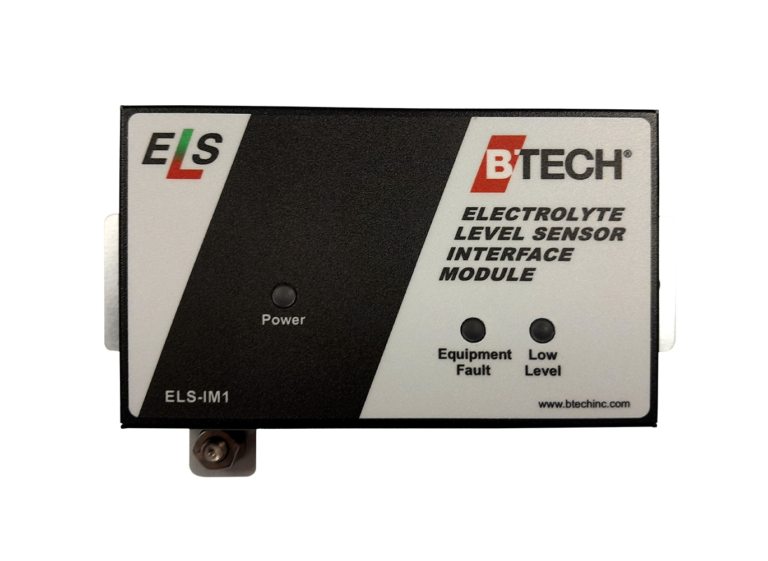
The BTECH Electrolyte Level Sensor (ELS) is an infrared sensor that watches the electrolyte level in flooded lead-acid batteries around the clock and sends a warning or alarm when a cell drops low, so you can add water before the plates are damaged.
On vented batteries, low electrolyte is a slow problem that a periodic walk-through can miss. This guide covers what the ELS measures, how big a system it covers, and where it fits with NERC PRC-005.
BTECH says low electrolyte levels can point to an impending malfunction, failure or permanent battery damage. Catching a low cell early lets you replace electrolyte before the plates corrode or acid builds up. The ELS is aimed at flooded batteries in industrial and remote utility systems.
Each cell gets an IR sensor mounted with non-crazing adhesive. The sensor watches the electrolyte against its level reference points, shown as max, minimum and low level. It has a low-level LED and an equipment alarm LED. A separate interface module has a green power LED, a red low-level alarm LED and a red equipment alarm LED.
BTECH describes it as a standalone sensor that needs no custom software or programming.
| Item | ELS |
|---|---|
| Technology | Infrared (IR) level sensing |
| Batteries | Flooded VLA batteries |
| Accuracy | +/-5 mm above or below the low-level line |
| System size | Up to 30 cells per channel, 4 channels, 120 cells total |
| Outputs | Two NC summary relays: one for low level, one for equipment alarm |
| Power | 24 VDC, 1.5 A maximum |
| Operating temperature | 5 to 40 °C |
| Operating humidity | 0 to 80% non-condensing at 0 to 30 °C, 0 to 50% non-condensing at 31 to 40 °C |
| Approvals | FCC and ETL. CE, RoHS and REACH are listed as pending |
BTECH's product page mentions up to 60 cells per system, while the sell sheet lists 30 cells per channel and 120 cells across four channels. Confirm the cell count for your plant with BTECH.
PRC-005-6 requires vented lead-acid batteries to have the electrolyte level inspected every 4 calendar months. Table 1-4(f) lists monitoring that can replace specific periodic checks, and each must include alarming. Electrolyte level monitoring in every cell replaces the periodic electrolyte level inspection. BTECH says the ELS supports PRC-005 requirements and cuts inspection time and labor. Confirm with BTECH and your compliance group how a given installation fits your PRC-005 program.
Yes. The BTECH S5 offers electrolyte level monitoring as an option, and the wiring diagram on the ELS sell sheet shows how it ties in. The ELS interface module takes the NC/NO relay output from the sensors to the auxiliary ports on an S5 controller (the SCM-500 in the diagram), with the sensors on the cells and a terminator at the end of the chain. That puts electrolyte alarms in the same system as the S5's impedance, voltage and temperature data. Confirm the exact wiring and compatibility for your S5 with BTECH.
Electrolyte level in each cell of a flooded lead-acid battery, with warning and alarm outputs at low levels.
+/-5 mm above or below the low-level line.
The sell sheet lists up to 30 cells per channel and 120 cells in four channels.
Flooded VLA batteries.
Through two normally closed summary relays, one for low level and one for equipment alarm.
The sell sheet diagram shows the ELS interface module wired to the auxiliary ports of an S5 controller. Check wiring details with BTECH.
It supports it. PRC-005-6 Table 1-4(f) lets alarmed electrolyte level monitoring in every cell replace the periodic electrolyte inspection. Check your own program with your compliance group.
For questions or a quote, contact Powertech Associates and UPSC at info@powertech-upsc.com or (860) 678-8772. Send us your battery type and number of cells.
