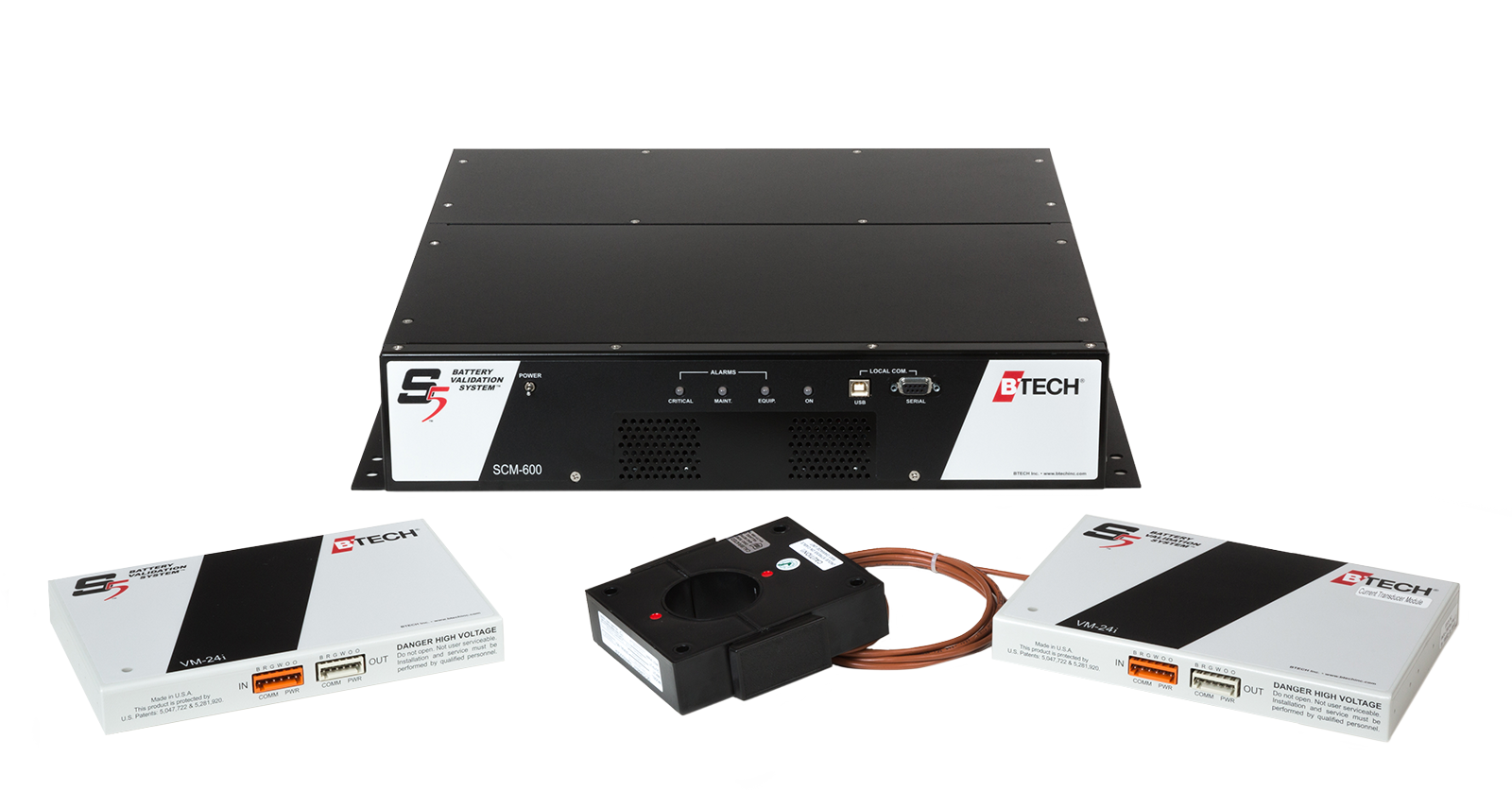
The BTECH S5 is a battery monitoring system that keeps watch on the DC batteries behind electric utility switchgear, tracking cell impedance, string current and temperature so a weak cell shows up long before a breaker fails to trip.
If you run substations, you already know the battery is the part nobody sees until it matters. Protective relays, breaker trip coils and SCADA communications all depend on the station DC supply. When a fault hits and the AC source drops, that battery is the only thing standing between a clean trip and a much bigger outage.
This guide covers what the S5 measures, why that matters for switchgear specifically, and how it fits the way utilities already maintain station batteries.
Most station battery trouble starts small: one weak cell, a corroded connection, or a charger drifting off float voltage. A bank-level voltage reading can look normal while a single cell is already in trouble.
According to a utility battery engineer writing for BattCon, one low cell may have little effect, or it may leave the whole battery unable to do its job. That is more common with VRLA batteries but happens with vented lead-acid too.
The usual trouble spots are:
Continuous monitoring does not make a battery last longer by itself. It shortens the time between a cell going bad and someone knowing about it.
The S5 is BTECH's flagship battery monitoring system. One system watches up to 480 individual cells across eight strings, on lead-acid, VRLA, VLA and NiCad batteries, including high amp-hour cells of 4000+ Ah. Specs below come from the BTECH S5 page and the S5 cut sheet.
| Measurement | Range | Accuracy |
|---|---|---|
| System and string voltage | 0 to 650 VDC (up to 1200 VDC in a delta configuration, optional) | +/-0.1% of full scale |
| Unit voltage | 1 to 20 VDC | +/-0.1% of full scale |
| Unit impedance | From 100 µΩ | +/-0.01 mΩ |
| String current | +/-100, 200, 600 or 3000 A, depending on the current transformer | +/-0.5% (100 and 200 A), +/-0.1% (600 A), +/-5% (3000 A) |
| Unit and ambient temperature | -35 to 70 °C | See the spec sheet |
Beyond the raw readings, the S5:
For integration, it has a network card, RS-232 and USB ports, Modbus over TCP/IP, SNMP, six programmable output relays and four programmable input relays. Alarms can go out by SMS or email through BVM software, and data is viewable in the BVM Windows software or the Online Battery Validation Manager portal.
The monitor runs on 110 to 250 VAC or 24 to 145 VDC at up to 100 W, and is rated for 5 to 40 °C. The S5 uses quick-disconnect safety fuses so batteries can be replaced more easily and safely. BTECH says each system is custom configured, pre-terminated and tested, uses fewer wires than other leading products and cuts installation time in half. Those are the manufacturer's claims, so ask for specifics on your own installation.
BTECH aims the S5 at electric utility substation batteries, mainly 130V and 250V systems with NiCad or VLA/VRLA cells and dual-charger setups. That is the DC supply behind switchgear: it powers protective relays, breaker trip and close circuits and communications when the AC source is gone.
NERC PRC-005-6 is why many utilities look at monitoring at all. It sets maximum maintenance intervals for station DC supplies, with separate tables for vented lead-acid (Table 1-4(a)) and VRLA (Table 1-4(b)) batteries. Here is the schedule as written in the standard:
| Activity | Vented lead-acid | VRLA |
|---|---|---|
| Verify station DC supply voltage; check for unintentional grounds | Every 4 calendar months | Every 4 calendar months |
| Inspect electrolyte level | Every 4 calendar months | Not applicable |
| Measure internal ohmic values of individual units | Cell condition inspected every 18 calendar months (ohmic values if cells are not visible) | Every 6 calendar months |
| Verify charger float voltage, battery continuity, terminal and intercell connection resistance; inspect rack | Every 18 calendar months | Every 18 calendar months |
| Verify battery performance: either evaluate cell/unit measurements against the baseline, or run a capacity test | Baseline evaluation every 18 calendar months, or capacity test every 6 calendar years | Baseline evaluation every 6 calendar months, or capacity test every 3 calendar years |
The standard also names monitoring that removes specific periodic activities. In Table 1-4(f), all of it must include alarming, and the list covers:
BTECH's utilities page lists what it associates with PRC-005-6 compliance monitoring: high and low float voltage, DC ground faults, string continuity, current on each string, inter-cell connections, internal ohmic values against baselines, and discharge data logging. The S5 also has an optional electrolyte level monitor. Confirm with BTECH which of these a given S5 configuration covers, and confirm with your compliance group how the monitoring fits your PRC-005 program.
One caution from the field: the BattCon paper's author sees battery monitors as a useful diagnostic that cuts labor, but not a substitute for periodic discharge testing on critical applications. Treat the S5 as a way to see problems sooner and document them, and decide with your compliance group how it relates to your capacity testing schedule.
The S5 does not replace your maintenance program. It changes how often you see the data and how well it is recorded.
| Periodic manual testing | BTECH S5 monitoring | |
|---|---|---|
| How often | At set intervals, such as every 4 months, 6 months or 18 months under PRC-005 | Continuous, real-time data collection |
| Cell impedance | Technician measures each unit and compares it to baseline | Each unit's impedance tracked against baseline |
| Between visits | A weak cell can go unnoticed until the next visit | Advance failure notifications by SMS or email |
| Records | Test sheets, dependent on method and technician | Logged data, including discharge event records |
| Access | Site visit | Remote analysis and troubleshooting |
| Capacity test | Scheduled discharge test on the bank | The S5 does not run a capacity test |
Before you specify a system, gather this:
The S5 is a battery monitoring system from BTECH that tracks voltage, impedance, current and temperature on stationary battery banks. It is used on utility substation batteries, data center UPS systems and telecom plants.
Up to 480 individual cells across eight strings per system, including high amp-hour cells of 4000+ Ah.
Lead-acid, VRLA, VLA and NiCad batteries.
BTECH positions it for 130V and 250V utility substation battery systems. The system and string voltage measurement range is 0 to 650 VDC.
It can support it. PRC-005-6 Table 1-4(f) says alarmed monitoring of items like station DC voltage, grounds, float voltage, string continuity, connection resistance and per-cell internal ohmic values removes the matching periodic checks. Which of those a specific S5 setup covers depends on its configuration, so confirm with BTECH and your own compliance group.
The S5 does not perform a capacity test. Treat it as a way to find problems earlier and keep better records, and work out with your compliance group how it fits your testing schedule.
It has Modbus over TCP/IP, SNMP, six programmable output relays and four programmable input relays, and alarms can go out by SMS or email through BVM software. Check your integration needs with your SCADA group and BTECH.
An optional programmable relay can turn off the battery charger or trip the battery breaker. It requires dual UVR or shunt trips.
No. BTECH custom configures each system for its application, with hardware and wiring designed around your battery plant.
For questions or a quote on the BTECH S5 battery monitoring system, contact Powertech Associates and UPSC at info@powertech-upsc.com or (860) 678-8772. Send us your battery type, voltage, number of cells and strings, and how you want alarms delivered, and we can help scope it.
