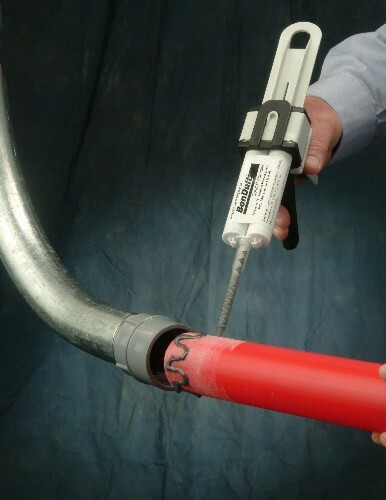
Polywater® BonDuit® Conduit Adhesive is a two-part resin adhesive designed to create strong, permanent, watertight, and airtight connections between polyethylene conduit and other conduit materials. It is commonly used to transition underground HDPE duct to PVC, fiberglass, rigid steel, and other conduit systems in electrical utility and infrastructure applications.
For utility contractors and electrical infrastructure professionals, BonDuit provides an alternative to traditional mechanical couplings when joining dissimilar conduit materials.
Polywater BonDuit is a rapid-curing, two-part conduit adhesive used to join polyethylene duct to PVC, fiberglass, and metal conduit using standard couplings and fittings.
The adhesive creates a durable bond designed to withstand movement and vibration while providing a watertight and airtight seal. Polywater also offers BonDuit XL, a larger-format version intended for larger conduit applications.
BonDuit is particularly useful when an underground HDPE conduit needs to transition to another conduit material above ground or at an electrical equipment installation.
Mechanical couplings are one method of joining conduit, but they can add components, labor, and installation steps.
BonDuit provides an adhesive-based connection that can be faster and more economical for certain applications. Polywater describes BonDuit as an alternative to mechanical couplings and reports stronger pullout strength than most mechanical coupling solutions.
For utility construction, this can be particularly useful where conduit transitions occur near:
No. Standard PVC cement does not bond HDPE in the same manner it bonds PVC.
This is one of the most important reasons BonDuit exists. When an installation requires HDPE to transition to PVC or another conduit material, a bonding system specifically designed for the materials involved should be used.
Polywater identifies BonDuit as a solution for joining polyethylene duct to PVC, fiberglass, and metal conduit and notes that PVC pipe cement does not bond HDPE.
A typical BonDuit installation involves preparing the conduit surfaces, applying the two-part adhesive, assembling the connection, and allowing the adhesive to cure.
The BonDuit kits are designed to provide the components needed for field installation, including adhesive cartridges, mixing nozzles, cleaning wipes, and sanding material. Certain kits also include the dispensing tool.
Always follow the current Polywater application instructions for the specific BonDuit product being installed.
Polywater® BonDuit® is the proven and reliable conduit adhesive for joining dissimilar conduit material types. This video provides an overview of the performance characteristics of Polywater® BonDuit® and the key advantages that make this conduit glue a desirable choice for installers in the electrical and telecommunications industries. Always follow the current Polywater application instructions for the product you are installing.
BonDuit is designed for a variety of conduit transitions. Depending on the specific application, Polywater identifies bonding applications involving:
It can also be used with applications involving transition couplings, concrete vaults, aboveground conduit, steel sweeps, and elbows.
Polywater offers two primary BonDuit formats.
| Product | Typical Application |
|---|---|
| BonDuit | Smaller conduit and general conduit bonding applications |
| BonDuit XL | Larger conduit applications, including 3-inch and larger conduit |
Polywater identifies BonDuit XL as an option for conduit measuring 3 inches (75 mm) and larger. The XL format also provides a longer work time than standard BonDuit.
BonDuit XL can also be used as a mechanical coupling for conduit diameters greater than 5 inches (125 mm), according to Polywater's product information.
Yes. BonDuit is designed to create watertight conduit joints. Polywater reports that BonDuit joints have been hydrostatically tested and withstood continuous pressure testing at 120 psi (8.3 bar) without leakage during the reported test.
This makes a watertight connection particularly valuable for underground electrical infrastructure where moisture intrusion into conduit systems can be a concern.
Yes. BonDuit forms an airtight seal in addition to its watertight connection. An airtight conduit transition can be valuable in utility applications where maintaining conduit integrity is important.
Yes. Polywater identifies both BonDuit and BonDuit XL as UL Recognized conduit adhesives. The products have been evaluated under the applicable UL polymeric adhesive requirements for indoor and outdoor use with electrical equipment.
Always verify the current product documentation and applicable project requirements before specifying the product.
Polywater states that BonDuit and BonDuit XL meet applicable NEC requirements for joining PVC, HDPE polyethylene, and RTRC fiberglass conduit, including NEC sections 352.48, 353.48, and 355.48.
For engineering and code compliance, the current NEC edition and project-specific requirements should always be consulted.
BonDuit is particularly useful for electrical utility and underground infrastructure applications. Common applications include:
One of the most common applications is transitioning underground HDPE duct to an aboveground conduit system.
BonDuit can be used when directionally bored HDPE duct needs to connect to PVC or another conduit material.
The durable adhesive bond can be useful around electrical equipment such as transformers.
BonDuit can also be used around switchgear and other electrical equipment where conduit transitions are required.
Its resistance to movement and vibration makes it suitable for applications where conduit systems may experience environmental movement.
Polywater's technical data reports third-party laboratory pullout testing for HDPE conduit joined using a PVC coupling and BonDuit. Reported typical pullout forces include:
| Conduit Diameter | Reported Pullout Force |
|---|---|
| 1 inch | 724 lbf |
| 1½ inch | 1,233 lbf |
| 2 inch | 2,025 lbf |
| 4 inch | 5,333 lbf |
These values are reported test results and should not be interpreted as guaranteed field performance for every installation. Actual performance depends on materials, preparation, installation conditions, curing, and other factors.
Polywater states that BonDuit develops high strength within approximately one hour under specified conditions.
Actual cure performance can vary with environmental conditions, including temperature and installation conditions. Always follow the current manufacturer's instructions before placing a connection into service.
The number of connections that can be made from a cartridge depends on conduit diameter and the specific BonDuit product. Polywater provides a BonDuit quantity calculator to help determine the number of adhesive cartridges required for an installation.
For project estimating, provide:
This makes it easier to determine the required quantity before beginning the installation.
For electric utilities and contractors, conduit transitions are often one of the most important parts of an underground-to-aboveground installation.
A typical application may involve:
Directionally bored HDPE → BonDuit → PVC coupling → PVC conduit → electrical equipment
This type of transition can provide a practical method for connecting different conduit systems while maintaining a strong, watertight and airtight connection.
Polywater BonDuit is used to create strong, watertight, and airtight connections between HDPE/polyethylene conduit and materials such as PVC, fiberglass, and rigid steel conduit.
Yes. BonDuit is specifically designed for joining polyethylene/HDPE duct to PVC and other conduit materials.
No. Standard PVC cement does not provide the appropriate bond to HDPE. A bonding system designed for HDPE and the mating conduit material should be used.
BonDuit is designed to create watertight conduit connections. Polywater reports successful hydrostatic testing of BonDuit joints.
Yes. BonDuit is designed to create airtight as well as watertight joints.
BonDuit XL is the larger-format version of Polywater's conduit adhesive and is an option for conduit sizes of 3 inches and larger.
Yes. Polywater identifies BonDuit and BonDuit XL as UL Recognized conduit adhesives.
Yes. Polywater states that BonDuit and BonDuit XL can be used for indoor and outdoor projects.
Yes. Polywater specifically identifies installations near transformers and switchgear as suitable applications.
Conduit size and the installation requirements are the primary considerations. BonDuit XL is designed as an option for 3-inch and larger conduit, while standard BonDuit is available in smaller cartridge formats.
When an electrical utility installation requires HDPE to transition to PVC, fiberglass, steel, or another conduit material, Polywater BonDuit provides a purpose-designed alternative to conventional mechanical coupling methods.
Its combination of strong bond, watertight seal, airtight seal, fast application and material versatility makes BonDuit a practical solution for many utility and electrical infrastructure applications.
Powertech Associates supplies products for electric utility construction, underground infrastructure, and electrical maintenance applications.
For Polywater BonDuit, BonDuit XL, replacement mixing nozzles, dispensing tools, and related Polywater products, contact Powertech Associates for product availability, pricing, and application assistance.
| Catalog # | Contents |
|---|---|
| BT-KITG* | 2 adhesive cartridges, 8 mixing nozzles, 1 strip of sanding cloth, 8 Type RP™ cleaning wipes (cat #RP-1), 1 dispensing tool |
| BT-KIT | 2 adhesive cartridges, 8 mixing nozzles, 1 strip of sanding cloth, 8 Type RP™ cleaning wipes (cat #RP-1) |
| BT-KITB6G* | Bulk package of 6 BT-KIT with 1 dispensing tool |
| BT-KITB6 | Bulk package of 6 BT-KIT |
| BT-CART12PK | 12 adhesive cartridges, 36 mixing nozzles |
| BTXL-250KIT1 | 1 BTXL 250-mL cartridge, 5 mixing nozzles, 5 pairs of gloves, sandpaper 24-in / 60-cm 80-grit, 5 RP-1L, instructions |
| BTXL-250CART12 | 12 cartridges and static mixers |
| BTXL-250KITB6 | 6 BTXL-250KIT1 |
| TOOL-50-11 | 1 dispensing tool |
| MXR-12T-10 | 10-pack of mixing nozzles |
*Includes the dispensing tool.
