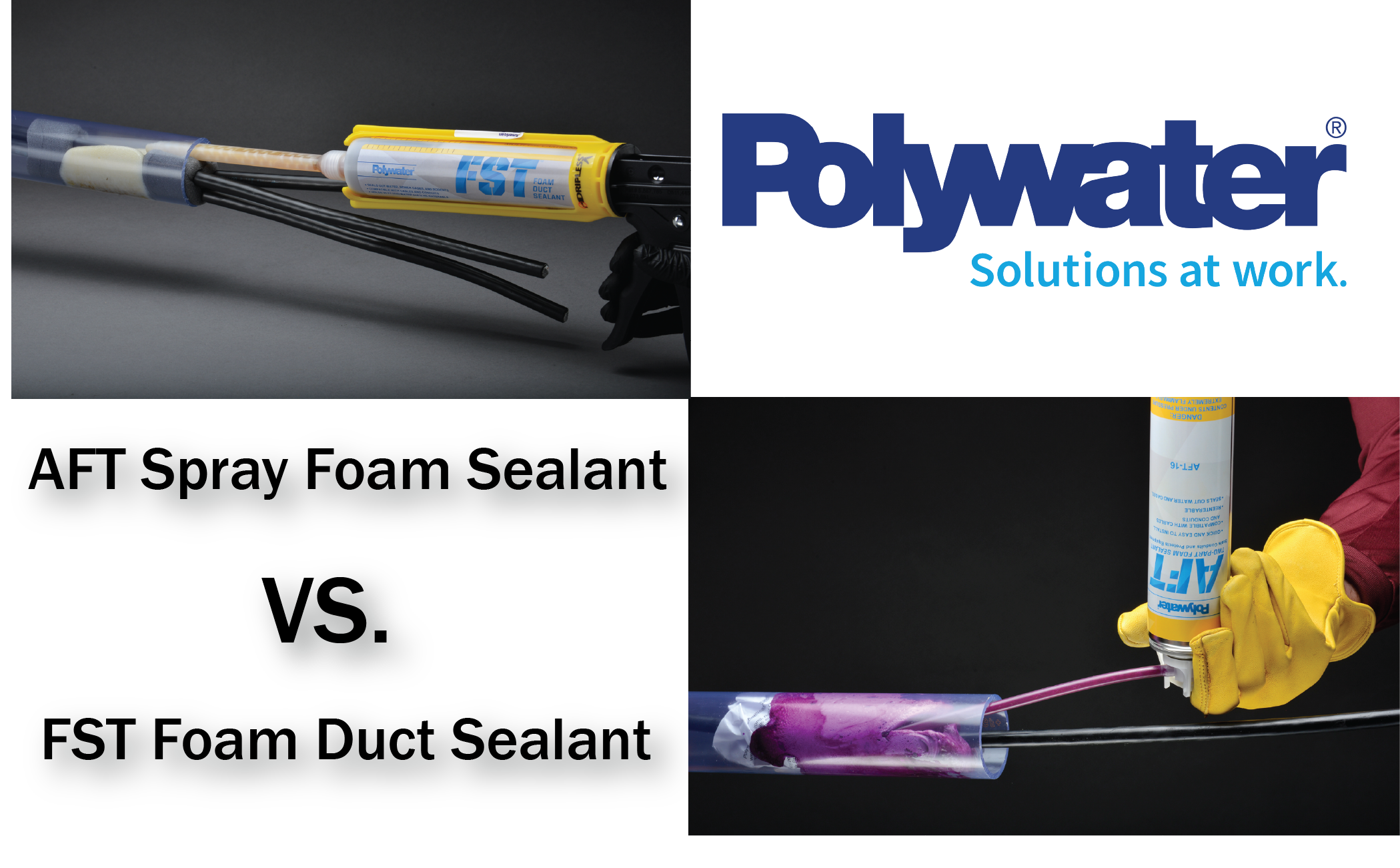
Use Polywater AFT for quick conduit seals where water and gas pressure are low, like risers and ground level conduit. Use Polywater FST when you need a serious seal, like an underground vault or a duct with real water pressure behind it. AFT comes in a spray can and holds about 11 feet of water head. FST comes as a cartridge you inject over a foam dam and holds 22 feet.
They are both closed-cell foams that seal around cable in a duct, and both can be cut back out later. They are just built for different jobs, so here is how to pick.
| AFT | FST | |
|---|---|---|
| Best for | Risers and ground level conduit with low water and gas flow | Underground vaults and heavy duty ducts with large water and gas flows |
| Form | 16 oz two-part spray can with actuator | Two-part cartridge with static mixer, used with foam strip dams |
| Water head | 11 ft | 22 ft |
| Gas | Holds 2 psi of air and passes UL 1203 style seal tightness tests | Blocks methane and other gases |
| Install temperature | 45 to 95 degrees F | 40 to 95 degrees F |
| Service temperature | -20 to 200 degrees F | -20 to 200 degrees F continuous |
| How fast | Fully expanded in under 2 minutes, tack free in 3 to 5 | Expands in 2 to 5 minutes, sets in 10 to 15 |
| Dams | Foam dam about 6 in. into the conduit, plus an outside dam | Two foam strip dams, one 5 in. deep and one flush with the entrance |
| Prep | Damp is fine, no flowing water | Sand and clean steel conduit, wire brush rust |
| Removal | Mechanical, with a long screwdriver | Mechanical, puncture and chip the foam out |
| Part numbers | AFT-16 (case of 15), AFT-16P4 (case of 4), actuators AFT-SAE10 and AFT-FAE10 | FST-250KIT1, FST-250, TOOL-250 caulking tool, FST-MINI for conduit under 2 in. |
The short version: AFT is fast and easy, and FST holds twice the water head.
Each AFT-16 package is one 16 oz can with two actuators. The difference between AFT-16 and AFT-16P4 is how many cans come in the case. These are Polywater's catalog numbers.
| Catalog # | Package | Units per case |
|---|---|---|
| AFT-16 | One 16 oz (470 ml) can and two actuators | 15 |
| AFT-16P4 | One 16 oz (470 ml) can and two actuators | 4 |
| AFT-SAE10 | Pack of 10 actuators with standard extension tube | 1 |
| AFT-FAE10 | Pack of 10 actuators with flexible extension tube | 1 |
FST comes in two sizes. Polywater recommends FST-250 for conduit 2 in. (50 mm) and larger, and FST-MINI for conduit under 2 in. These are Polywater's catalog numbers, and the full details are in Polywater FST: FST-250 and FST-MINI catalog numbers.
| Catalog # | Package | Units per case |
|---|---|---|
| FST-250KIT1 | Kit with one 8.5 oz (240 g) two part FST-250 tube, 3 mixing nozzles, 4 damming strips, abrasive strip, gloves, foam dam positioning rod, pre-treating wipe, resealing cap and instructions. Caulking tool sold separately (TOOL-250). | 1 |
| FST-250KIT | Six FST-250KIT1 kits | 6 |
| FST-250 | One 8.5 oz (240 g) two part FST-250 tube, one mixing nozzle and one resealing cap | 12 |
| MXR-41T-10 | Ten pack of mixing nozzles for FST-250 | 1 |
| TOOL-250 | High ratio caulking gun | 1 |
| FST-DAM | 24 in. (61 cm) foam damming strip | 24 |
| FST-MINI-1 | One 50 ml FST-MINI cartridge, 2 mixing nozzles, 6 foam discs, gloves and instructions | 1 |
| FST-MINI-1G | FST-MINI-1 plus TOOL-50-11 dispensing tool (US only) | 1 |
| FST-MINI-B6 | Six FST-MINI units | 1 |
| FST-MINI-B6G | Six FST-MINI units plus TOOL-50-11 (US only) | 1 |
| TOOL-50-11 | Dispensing tool for FST-MINI | 1 |
| MXR-20T-10 | Ten pack of mixing nozzles for FST-MINI | 1 |
Pick AFT when you need to seal a conduit quickly and the conditions are mild. Riser poles, ground level conduit, and telecom ducts with a little moisture are all good fits.
It is a two-part urethane in a can. You shake it for 60 seconds, spray it in over a dam, and it expands to about twice its volume in under two minutes. Polywater says it seals conduits from 3/4 in. up to 10 in. against water, gas, insects, rodents and dust, and it complies with the NEC and NESC sealing requirements.
A few tips from the data sheet:

Pick FST when the seal is going to see real pressure. Think underground vaults, manholes and heavy duty ducts where there are large flows of gas and water behind the seal.
FST holds 22 feet of water head and blocks methane and other gases. It bonds to metal, concrete and plastic, and it is meant to be a semi-permanent seal you can still re-enter. You build two foam strip dams around the cable, push them into the duct, then inject the foam above the cable with a static mixer. It sets in 10 to 15 minutes, and you can add more later because it bonds to cured foam.
A few tips from the data sheet:

Yes, and plenty of crews do. A pole riser might get AFT and the vault it runs into gets FST. Match the product to the water and gas pressure at each spot, not to the whole project.
AFT is a spray can foam for lower pressure conduit seals. FST is a cartridge foam for high pressure seals, rated for 22 feet of water head.
AFT holds 11 ft of water head and FST holds 22 ft.
Yes. Both are re-enterable and are removed mechanically, by puncturing the foam and chipping or carving it out. De-energize equipment first.
AFT at 45 to 95 degrees F, and FST at 40 to 95 degrees F. Both are rated for service from -20 to 200 degrees F.
Yes, both use foam dams to hold the liquid foam where you want it.
No. A little dampness is fine for AFT, but flowing or excess water weakens both seals. FST tolerates a small amount of water, under 10 percent of the duct.
The shelf life is 12 months, and you can use a can for a month after first use.
Both are one 16 oz can with two actuators. AFT-16 comes 15 to a case and AFT-16P4 comes 4 to a case.
Utility Power Supply Company (UPSC) and Powertech Associates represent Polywater across New England and New York State. You can order the AFT-16 spray foam sealant, the AFT-16P4 four can package, the AFT-SAE10 actuators, the AFT-FAE10 flexible nozzles, the FST-250KIT1 kit and the FST-250 cartridge in our online store.
Not sure which one your job needs? Contact us at info@powertech-upsc.com or (860) 678-8772.
Last updated: November 2026.
