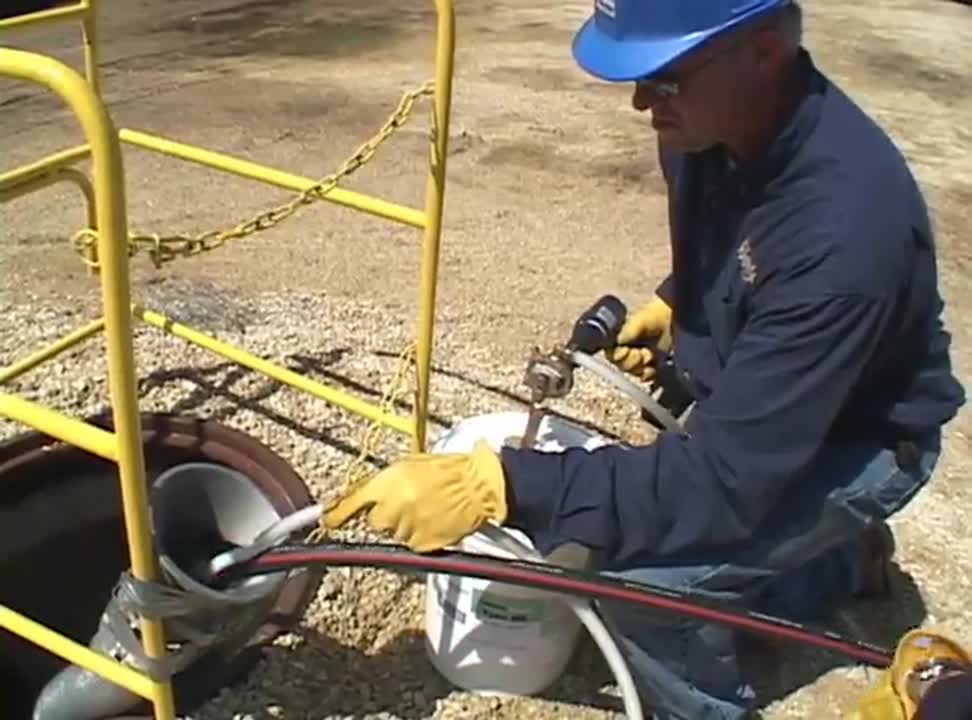
Pick the wrong pulling lubricant and the pull tells you right away. Tension climbs, a jacket gets scuffed, or the lube drips out of a vertical run before the cable gets halfway. Polywater makes a lubricant for almost every pulling situation, and the names (J, PJ, LZ, NN, CLR, Dyna-Blue) do not explain themselves. This guide sorts them out by what you are pulling, where, and in what weather.
Lubricant lowers the friction between the cable jacket and the conduit, so pulling tension stays under the cable's limit. Polywater recommends lubricating any cable that will be re-pulled, any pull longer than 15 feet, and any pull with more than 90 degrees of total bend. Lower tension means less risk of damage to the cable and a better chance of finishing a long pull in one go.
| Lubricant | Best For | Form | Winter Grade | Common Catalog Numbers |
|---|---|---|---|---|
| Lubricant J | Long pulls, multiple bends, hot weather | Semi-thick gel | WJ | J-35, J-128, J-640 |
| Lubricant PJ | Same jobs as J when you want to pour or pump it | Pourable | WPJ | PJ-128, PJ-320 |
| Lubricant LZ | LSZH/LSHF, CPE, CSPE, fire-rated and plenum jackets | Semi-thick gel | WLZ | LZ-35, LZ-128, LZ-640 |
| Plus Silicone Type NN | Long, critical underground pulls and wet or water-filled conduit | Thin gel | WNN | NN-128, NN-320, NN-640 |
| CLR Clear | Everyday electrical pulls applied by hand | Thick clear gel | None listed | CLR-35, CLR-128, CLR-640 |
| Dyna-Blue | Everyday general electrical pulls applied by hand | Thick gel | None listed | D-35, D-128, D-640 |
| Lubricant A | Basic underground pulls, poured or pumped | Pourable | None listed | A-32, A-128, A-640 |
The short version: J for most utility and industrial pulls, PJ when you need it pourable, LZ for fire-rated and low smoke jackets, NN for long or wet underground pulls, and CLR or Dyna-Blue for everyday hand-applied work.
If you are looking to reduce friction on your cable pull, increase the blowing or pulling distance, reduce the number of splices, and minimize damage to the cable, then you probably know you need a lubricant. This video covers the three key factors for choosing the right one.
Lubricant J is Polywater's go-to water-based gel for long pulls with multiple bends. It clings to the jacket through the pull, can be pumped, hand applied, or delivered with Front End Packs, and it is slow drying. It is unaffected by freeze and thaw cycles and works in hot weather, and the dried residue does not support combustion or spread flame. J passes IEEE 1210 physical and electrical testing and is UL Listed.
It is clean and non-staining, which helps on finished indoor work. For pulls in cold weather, the winter grade (WJ) can be applied down to -20°F (-30°C).
| Regular | Winter | Package |
|---|---|---|
| J-35 | WJ-35 | 1 qt bottle |
| J-27 | WJ-27 | 1 qt FEP bag in carton |
| J-99 | WJ-99 | 1 qt FEP bag in 5 gal pail |
| J-55 | WJ-55 | 1/2 gal FEP bag in carton |
| J-110 | WJ-110 | 1/2 gal FEP bag in 5 gal pail |
| J-128 | WJ-128 | 1 gal pail |
| J-640 | WJ-640 | 5 gal pail |
| J-DRUM | WJ-DRUM | 55 gal drum |
PJ is the pourable version. It is a clean, slow-drying, water-based lubricant you can pour or pump straight into conduit, with less mess than hand application. It stays on the jacket, is unaffected by freeze/thaw cycles and heat, and has no flash point. Dried residue does not support combustion and it does not cement the cable in the conduit. Listed LLDPE, XLPE and PVC jackets aged in PJ per IEEE 1210 meet that standard's tensile and elongation retention requirements.
PJ is not recommended for LSZH/LSHF jackets or certain CSPE and CPE jackets. Use LZ for those. The winter grade (WPJ) can be applied down to -20°F. It comes in 1 gal (PJ-128), 2.5 gal (PJ-320), 5 gal (PJ-640), and 55 gal (PJ-DRUM) sizes, and in winter grade as WPJ-128 and WPJ-320.
LZ is the lubricant to specify when the cable jacket is LSZH/LSHF, CPE, CSPE, fire-rated or plenum. Polywater describes it as suitable for all cable jacket types, with a spec-grade formulation for power and industrial plants, mass transit, high-occupancy buildings, airports and data centers. It contains no grease or wax, will not cement cables in conduit, and keeps lubricating after it dries. It does not stress crack polyethylene, passes IEEE 1210 testing, meets Telcordia GR-356-CORE, and is UL Listed, including to Canadian safety standards.
LZ can be pumped or hand applied and is available in Front End Packs. Sizes run from the 1 qt bottle (LZ-35) through 1/2 gal (LZ-55, LZ-110), 1 gal (LZ-128), 5 gal (LZ-640) and 55 gal (LZ-DRUM). Winter grades are WLZ-35, WLZ-128, WLZ-640 and WLZ-DRUM. A pourable version, PLZ, is also available from Polywater.
Type NN is for the hard jobs: long, critical underground transmission pulls, continuous polyethylene conduit, and conduit with water in it. The silicone chemistry lets it cling to the cable through water, so it keeps reducing tension where other lubricants wash off. It is a thin gel you can pour, pump or apply by hand, it dries slowly, and it leaves a thin film that stays effective for months. It is designed for HDPE duct, PVC conduit and PE jackets, passes IEEE 1210 testing, and meets Telcordia GR-356-CORE.
NN comes in 1 gal (NN-128), 2.5 gal (NN-320), 5 gal (NN-640) and 55 gal (NN-DRUM) sizes. The non-freezing winter grade is WNN-128 or WNN-640, good to -20°F.
Not every pull is a long one. For routine work where the crew is applying lubricant by hand, Polywater makes two thick gels that stay put.
CLR is stocked as CLR-35, CLR-128 and CLR-640. Dyna-Blue is D-35, D-128 and D-640.
Polywater also makes a set of lubricants for communications work:
Prelube 2000 increases the distance fiber optic cable can be installed in a continuous length when using blowing and jetting machines.
Standard lubricants thicken or freeze in the cold. Polywater's winter grades add anti-freeze so they can be applied at temperatures as low as -20°F (-30°C). The winter versions use a W prefix: WJ, WPJ, WLZ and WNN, among others. Keep the lubricant as warm as you can before the pull.
Polywater gives a simple formula: Q = k x L x D, where Q is gallons, L is pull length in feet, D is conduit inside diameter in inches, and k is 0.0015. A 500 foot pull in 4 inch conduit works out to 3.0 gallons. As a rule of thumb, plan on about 1 gallon per 100 feet of cable.
Add up to 50 percent for old or rough conduit, high conduit fill, several bends, or high temperatures. Do not add water to stretch the lubricant, since it changes the friction and sidewall pressure.
For pumped application, Polywater makes the LP-D5 drill-powered lubricant pump.
Front End Packs are a great way to lubricate cables and prelubricate conduits without touching the lubricant. Clean and easy to use Front End Packs get lubricant where the rub is. Available in summer and winter grade formulas.
Apply Polywater cable pulling lubricants using Polywater pumps. They apply lubricant more evenly and make clean up a snap.
The video demonstrates how to properly apply cable pulling lubricant to cables by hand application. Polywater lubricants are easy to handle, don't stain your clothes, don't cold flow, have clingability and wipe clean and dry off your cables so your wire markers will stick.
Polywater's SPY lube is a liquid polymer lube with enhanced thin film lubricant technology. Use sprayers to equally apply lubricant onto cables as they enter conduits or feeder tubes.
Lubricant J is Polywater's general-purpose, water-based gel for long pulls with multiple bends and hot environments. It is UL Listed and passes IEEE 1210 testing.
Both are slow-drying, water-based lubricants that cling to the jacket. J is a semi-thick gel, and PJ is pourable so you can pour or pump it into conduit with less mess.
Polywater LZ (pourable PLZ) is designed for LSZH/LSHF, CPE, CSPE, fire-rated and plenum jackets. PJ and Lubricant A are not recommended for LSZH/LSHF or certain CSPE and CPE jackets.
Plus Silicone Type NN. The silicone lets it cling to the cable in water and keep reducing friction.
Yes, with a winter grade. WJ, WPJ, WLZ and WNN can be applied down to -20°F (-30°C).
No. J, PJ, LZ, CLR and Dyna-Blue all dry slippery without cementing the cable in the duct, which keeps future pulls and cable removal easier.
Use gallons = 0.0015 x pull length in feet x conduit inside diameter in inches, and add up to 50 percent for hard pulls. About 1 gallon per 100 feet is a good starting point.
Prelube 2000 for fiber cable in duct, and Prelube 5000 for microcable in microduct.
Polywater CableFree Loosener dissolves wax-based lubricants and other residues to help with cable removal.
Powertech Associates supplies Polywater products to electric utilities, line contractors and municipal crews. You can shop Polywater lubricants online. For help matching a lubricant to your cable jacket and conduit, bulk drums, or winter grade availability, contact Powertech Associates.
Learn more on the manufacturer's page: Polywater Lubricants. Always check the current technical data sheet and the cable manufacturer's approvals for your jacket type.
