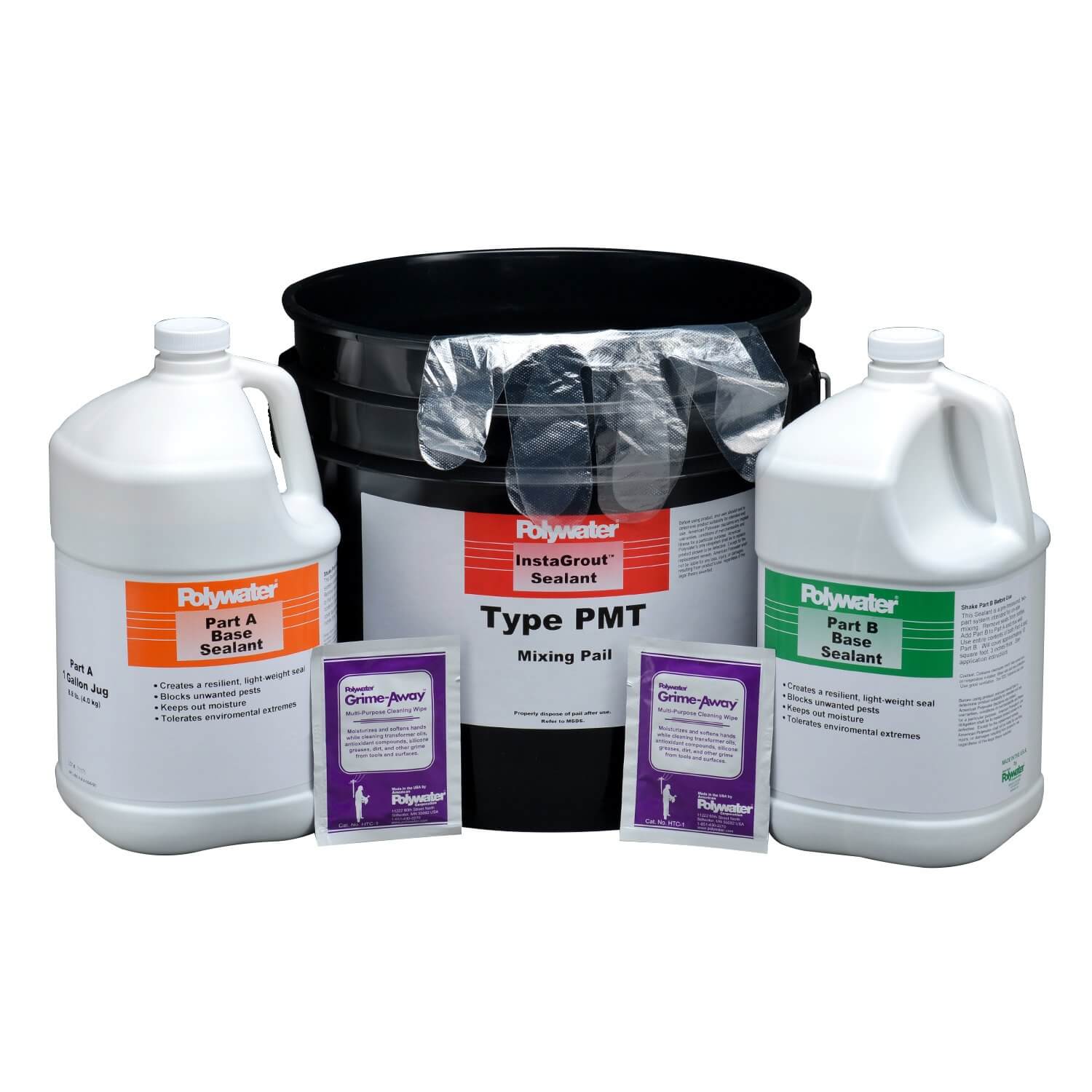
Polywater InstaGrout is a two-part urethane foam you pour into the open space around conduit and cable at the base of pad-mounted equipment. It flows, expands to fill the gaps, and cures into a closed-cell seal that keeps rodents, snakes, insects and water out. It was built for utility transformer pads, and the same open-bottom problem shows up under generators and EV chargers, so it is worth knowing how it fits each one.
Polywater is on board with using it for utility, generator and EV charging pads, along with switchgear, sectionalizing cabinets and solar inverters.
Most pads have a cutout where conduit and cable come up into the equipment. Once the cable is in, there is usually still open space around it. Mice, rats, snakes and insects find it, and so does water. A critter in the wrong spot can cause an outage, and moisture and dirt shorten the life of the gear.
The old fix was stuffing in rags, mesh or sand, or pouring a grout that cracked when someone had to cut it back out. InstaGrout was made to be a cleaner answer.
It is a two-part reactive urethane. Part A is a brown resin and Part B is a clear curing agent. You mix them, pour the mix onto the opening, and it flows, self-levels and then expands to fill the space around the conduit and cable. It cures to a closed-cell foam that is fire resistant and does not absorb water.
A few things crews like about it:
Yes, that is what it was made for. Polywater lists transformer pads, J boxes, control cabinets and switchgear base openings, and its flyer adds sectionalizing cabinets and solar inverters. It also works for leveling a transformer base and for equipment replacements where the new unit has a different footprint from the old one.
A standby generator on a concrete pad has the same issue as a transformer. Fuel, power and control conduits come up through the pad into the enclosure, and the gaps around them are an easy way in for rodents and water. Generators sit idle most of the time, so a nest can go unnoticed until the day you need the unit to start.
Sealing those openings with InstaGrout is the same job as sealing a transformer pad: measure the opening, mix, pour and let it expand. Keep the foam clear of anything that needs to vent or drain.
EV chargers are a growing source of this problem. A DC fast charger or a pedestal charger sits on a pad with conduit coming up from below, and the cabinet is often open at the bottom, much like a small pad-mount. Charging sites tend to be in parking lots and on roadsides, where rodents, rain, snowmelt and road salt are all part of the day.
Poured InstaGrout seals around that conduit and keeps water and animals from getting into the cabinet. Follow the product instructions and the charger maker's guidance. The ability to drill it back out also helps when you add chargers to an existing site.
The instruction sheet in the kit has the full procedure. The short version from the technical data sheet:
Apply it between 35 and 110 degrees F. At 70 degrees F the seal forms in about 20 minutes and it is fully cured in about an hour. At 35 degrees F that stretches to 1 hour and 4 hours.
Coverage below is at a 3 inch depth. Pick by the area of the opening.
| Kit | Package | Covers about | Units per case |
|---|---|---|---|
| PMT-1 | 750 mL burst pack, gloves, instructions | 1 sq ft | 2 |
| PMT-2 | 1500 mL burst pack, gloves, instructions | 2 sq ft | 2 |
| PMT-3 | Part A and B bottles, mixing pail and stick, gloves, instructions | 3 sq ft | 1 |
| PMT-10 | Part A and B jugs, mixing pail, gloves, instructions | 10 sq ft | 1 |
The burst packs are the easy choice for a single pad-mount or a charger. The PMT-3 and PMT-10 suit larger openings and crews doing several pads.
Polywater says it keeps rodents, snakes, insects and water out of enclosures.
35 to 110 degrees F. Once cured it handles -20 to 200 degrees F continuously.
About an hour at 70 degrees F, with the seal forming in around 20 minutes.
Yes. Cured foam can be drilled with wood auger bits or hole saws, and it can be resealed after the new cable goes in.
UV can turn the surface yellow, but Polywater says it does not hurt performance. Acrylic, urethane and epoxy coatings stick to it if you want to cover it.
18 months, stored cool, dry and out of the sun.
Wipe unreacted material with Grime-Away Multipurpose Cleaner. Cured foam has to be scraped or sanded off.
Unreacted resin can sensitize some people, so wear gloves and eye protection and read the SDS. Once reacted it can be considered non-toxic.
Utility Power Supply Company (UPSC) and Powertech Associates represent Polywater across New England and New York State. You can order the PMT-1, PMT-2, PMT-3 and PMT-10 InstaGrout kits in our online store. We can also help you size the opening and set up a demo for your crews.
Contact us at info@powertech-upsc.com or (860) 678-8772.
