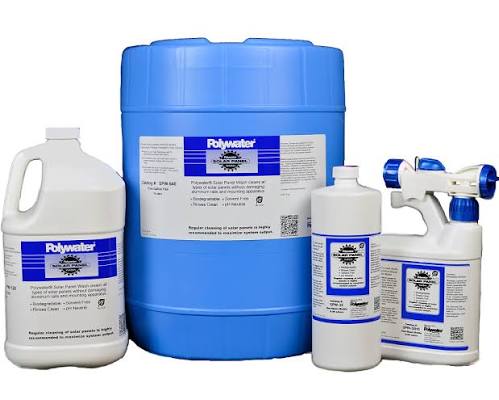
Polywater® Type SPW™ Solar Panel Cleaner is a concentrated, water-based cleaning solution designed to remove dirt, dust, pollen, bird droppings, air-pollution residue, and other contaminants from photovoltaic (PV) solar panels. Its specialized formulation helps solar operators maintain clean panel surfaces, support energy production, and reduce water consumption during routine solar panel maintenance.
For utility-scale solar farms, commercial solar installations, industrial facilities, and residential solar systems, Polywater Solar Panel Wash offers an efficient alternative to relying on water alone or conventional cleaning products. You can explore Polywater Type SPW Solar Panel Cleaner on the manufacturer's site.
Solar panels rely on sunlight reaching their photovoltaic cells to generate electricity. When dust, pollen, bird droppings, and other environmental contaminants accumulate on the glass surface, they can obstruct sunlight and reduce energy production.
Routine solar panel cleaning helps remove these contaminants, maintain system performance, and support the long-term operation of a solar installation. Uneven contamination can also contribute to localized hot spots under certain conditions.
Polywater Type SPW is specifically formulated to clean solar panel surfaces more effectively than conventional cleaning products or water alone, helping solar operators maintain their installations.
Polywater SPW is designed to address several common challenges associated with solar panel maintenance.
The concentrated cleaning solution helps remove a broad range of contaminants, including:
Removing these contaminants helps keep solar panel surfaces clean and clear for sunlight exposure.
Water availability and cleaning costs can be significant considerations when maintaining large solar arrays. Polywater SPW is formulated to lift contaminants more effectively than water alone, helping reduce the amount of water needed during cleaning.
Polywater reports field testing in which a 25:1 water-to-cleaner mixture reduced water consumption by a factor of 15 compared with the previous water-only cleaning procedure. Actual savings will vary according to the installation, cleaning method, and contamination level.
Polywater SPW contains a rinsing aid designed to help the solution rinse clean without spotting. This can eliminate the need for deionized (DI) or reverse-osmosis (RO) water in typical applications.
For solar maintenance contractors and operators managing large installations, avoiding specialized rinse water can simplify logistics and potentially lower operating costs. DI water may still be appropriate in areas with hard water.
Polywater states that SPW is designed to clean solar panels without degrading anti-reflective films or damaging specialty polymer coatings. Its formulation is also designed to avoid oxidation or abrasion of metallic rails and mounting brackets when used as directed.
The product is noncorrosive, contains no solvents, and is considered readily biodegradable based on OECD guidelines.
Always follow the solar panel manufacturer's cleaning instructions and the current Polywater product documentation.
Polywater Type SPW is suitable for maintenance applications involving:
The appropriate cleaning method and frequency depend on environmental conditions, panel orientation, local water quality, and the solar panel manufacturer's recommendations.
Polywater recommends starting with a dilution ratio of 1 part Solar Panel Wash to 25 parts water. Heavily soiled panels may require a higher cleaner concentration.
For routine cleaning, follow these general steps:
Work in manageable sections so the solution does not dry before brushing and rinsing. Follow all product instructions and site-specific electrical safety procedures.
Polywater's residential cleaning guidance lays out a short pre-cleaning routine that applies to any array, whether it is commercial, community solar or residential.
Hose-attached cleaning systems with extendable poles are a common choice for residential arrays because they reach roof-mounted panels from the ground. Many include a brush for scrubbing before a final rinse. Use the softest brush you can get, since a stiff one can scratch the glass.
Many panel manufacturers have historically recommended water only, preferably deionized water to reduce mineral spotting. Polywater's position is that water by itself is not very effective. Panels in dry, agricultural, coastal, volcanic, airport, bird-path or industrial areas can lose output quickly, and some contaminants do not rinse off with water alone. That includes bird droppings, jet fuel residue, plant matter, dust, sand and pollen.
Polywater's guidance lists eight things any panel cleaning additive should meet. A product should:
Polywater says SPW was built to meet these guidelines. Following them helps a system reach its theoretical maximum output, extends equipment life and improves return on investment.
Reasons why a cleaner specially developed for solar panels is better to use than common household cleaning products. Always follow the manufacturer's instructions and the solar panel manufacturer's cleaning requirements.
Polywater lists the following Type SPW packaging options:
| Catalog # | Package description |
|---|---|
| SPW-35HS | 1-quart bottle with hose sprayer attachment |
| SPW-35LF | 1-quart bottle with flip-top closure |
| SPW-128 | 1-gallon jug |
| SPW-640 | 5-gallon pail |
The quart hose-sprayer option is convenient for smaller cleaning jobs, while gallon and five-gallon containers can be useful for maintenance teams and larger installations.
Confirm current availability, case quantities, and ordering requirements with your supplier.
Polywater SPW is a concentrated cleaning solution formulated to remove dust, pollen, bird droppings, air-pollution residue, and other contaminants from photovoltaic solar panels.
Polywater states that SPW cleans more effectively than water alone. Its formulation helps lift contaminants from the panel surface, potentially reducing water use and cleaning effort.
Not typically. Its rinsing aid is designed to provide a clean rinse without requiring DI or RO water in typical applications. DI water may be beneficial in areas with hard water.
The recommended starting dilution is 1 part SPW to 25 parts water. Heavily contaminated panels may require a higher concentration. Always consult the current technical data sheet for application instructions.
Polywater states that SPW is formulated to avoid degrading anti-reflective films and specialty polymer coatings when used as directed. Users should also follow the panel manufacturer's maintenance requirements.
Yes. Polywater identifies utility-owned solar farms, industrial arrays, commercial installations, and residential rooftop and ground-mounted systems as intended applications.
Cleaning can improve energy production when accumulated contamination is reducing sunlight reaching the photovoltaic cells. The improvement depends on the amount and type of soiling, weather conditions, and the installation's operating characteristics.
Early in the day or at night, when the panels are cool. Cold water on hot panels can cause microfractures, and water can evaporate before it lifts the dirt.
Polywater's checklist covers compatibility with panel films, rails and racking, panel manufacturer approval, low environmental impact and toxicity, a formula for common contaminants, a clean spot-free rinse, use with tap or DI water, and hygroscopic dirt lifting.
For utility buyers, solar maintenance contractors, facility managers, and electrical supply professionals, Polywater Type SPW provides a specialized option for routine photovoltaic panel maintenance.
Powertech Associates and Utility Power Supply serve the electrical utility and industrial supply markets. Shop Polywater SPW Solar Panel Cleaner in our online store, or contact Powertech Associates to confirm availability, pricing, and ordering details.
Learn more on the manufacturer's page: Polywater Type SPW Solar Panel Cleaner. Review the manufacturer's technical data sheet and safety data sheet before use.
