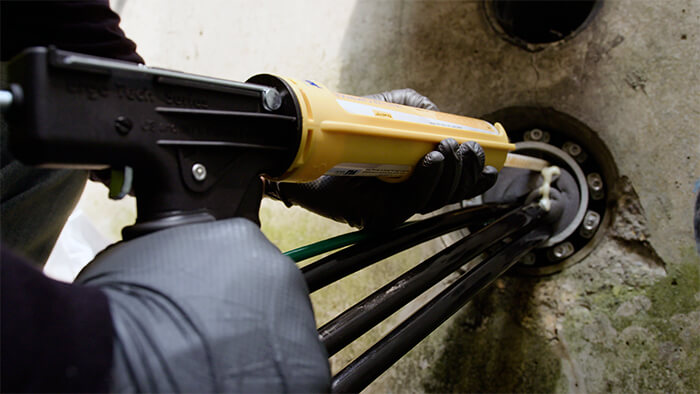
Polywater makes three foam sealants for conduit and duct. FST is a caulking-tube foam for conduits from 2 to 8 inches. AFT is an aerosol foam for conduits from 3/4 to 10 inches. ZipSeal is a two-syringe foam kit for small conduits, communication innerducts and thin annular spaces. All three are two-part urethane foams that expand and harden into a closed-cell seal that blocks water and gas.
| ZipSeal | FST | AFT | |
|---|---|---|---|
| Form | Two 25 ml syringes with mixing nozzles | Caulking tube with mixing nozzle | 16 oz aerosol can |
| Best for | Small conduits, communication innerducts, thin annular spaces | Conduits from 2 to 8 inches | Conduits from 3/4 to 10 inches |
| Water head | 30 ft (9 m) | 22 ft continuous, 90 ft intermittent | 11 ft on PVC, 6 ft on rigid steel |
| Gas | Blocks gas and water | Blocks at least 5 psi; passed 20 psi for 168 hours | Held 2 psi for 48 hours on PVC |
| Application temperature | 35 to 95 degrees F | 35 to 95 degrees F | 45 to 95 degrees F |
| Service temperature | -20 to 200 degrees F continuous, -40 to 250 degrees F peak | -20 to 200 degrees F continuous | -20 to 200 degrees F |
| Setup | Mesh strip for horizontal and vertical runs | Damming strips hold the foam; works in any orientation | Foams immediately; works vertically without a dam |
| Foaming at 70 degrees F | Fully expanded in about 1 minute, hard in 2 | 4 to 5 minutes, skin in 7 to 9 | Rises in 2 to 3 minutes, tack-free in 3 to 5 |
| Contact length along the cable | About 2 in. (5 cm) | About 3 in. (7.6 cm) | About 6 in. (15 cm) |
| Seals per package | One cartridge seals from five 2 in. ducts up to fifteen 1 in. ducts | Depends on conduit size and fill; Polywater has an FST foam quantity calculator | One can seals from one 8 in. conduit up to fifteen 2 in. conduits |
| Fire | Flame retardant | Fire retardant under UL 94; classified for surface burning characteristics | UL Recognized to UL 94, Class HBF |
| Shelf life | A part-used syringe keeps for up to a month in its pouch | 15 months; one month once opened | 12 months |
Polywater's FAQ says to position cables before sealing, because wires can't be moved after injection. The foams are removable: pierce the foam around the inner wall with a long rigid tool, break the bond, and pull the plug.
| Job | Pick | Why |
|---|---|---|
| Communication innerducts and small conduits | ZipSeal | Syringe kit sized for small ducts and thin annular spaces |
| Large conduits entering a vault, building or manhole | FST | Tested to 8 in. and rated 22 ft continuous |
| Vertical conduits or quick jobs on many sizes | AFT | Aerosol foam rises right away, with no dam needed vertically |
| Mixed conduit sizes on one job | AFT | One can seals from one 8 in. conduit to fifteen 2 in. conduits |
| Product | Catalog number | What it is |
|---|---|---|
| FST | FST-250 | Caulking tube, 1 mixing nozzle, resealing cap |
| FST | FST-250KIT1 | Tube, 3 nozzles, 4 damming strips, abrasive strip, gloves, positioning rod, wipe, cap, instructions |
| FST | FST-250KIT | Case of 6 FST-250KIT1 kits |
| FST | TOOL-250 | High-ratio dispensing tool, sold separately |
| FST | MXR-41T-10, FST-DAM | 10-pack of mixing nozzles; one 24 in. damming strip |
| AFT | AFT-16 | One 16 oz can with 2 actuators |
| AFT | AFT-16P4 | Four-can version |
| AFT | AFT-SAE10, AFT-FAE10 | 10-pack of actuators with standard or flexible extension tube |
| ZipSeal | ZIP-25KIT1 | 2 x 25 ml syringes, 5 mixing nozzles, mesh strip, gloves, instructions |
| ZipSeal | ZIP-25KITB6, MXR-24L-10 | Case of 6 kits; 10-pack of nozzles |
Polywater's instruction sheet (87037-002) gives approximate quantities. A mark is a graduation on the side of the syringe.
| Duct size | Liquid ZipSeal | Mesh strip needed |
|---|---|---|
| 3/4 in. (20 mm) and below | 1 full mark | 1 in. (25 mm) or less |
| 1 in. (25 mm) | 2 full marks | 1 in. (25 mm) |
| 1 1/4 in. (32 mm) | 2 full marks | 2 in. (50 mm) |
| 1 1/2 in. (38 mm) | 3 full marks | 4 in. (100 mm) |
| 2 in. (50 mm) | 5 full marks | 6 in. (150 mm) |
| Step | What to do |
|---|---|
| 1 | Clear loose debris or rust and clean the surfaces. Let any solvent dry first. Sand or abrade for best adhesion. Steel conduit must be sanded and cleaned. |
| 2 | Tear off the mesh strip length from the table and insert it 1 in. past the duct opening. Weave it between the wires to separate them. |
| 3 | Screw the static mixer onto the upright syringe |
| 4 | Inject a full mark at each injection point, about 5 seconds per mark, from the bottom of the opening to the top and around the wires and edges. The more you spread the injections, the better. |
| 5 | Do not count marks until foam leaves the mixer tip. Insert the mixer about 1 in. into the mesh strip. |
| 6 | Foam starts to expand in 10 to 20 seconds. Do not move the wires. Then take off the mixer and put the plug back on right away. |
| 7 | It is fully expanded in about 1 minute and hard in 2. Look for gaps and fill them with more foam. |
For vertical work, wrap the mesh tighter and insert it about 3 in. deep. For annular spaces, Polywater gives about 1.25 cubic inches (20 cm3) per mark. For an active water leak, Polywater describes a double-seal method: a first seal to stop most of the flow, then dry the duct and make the full seal. Install between 35 and 95 degrees F. Wear eye protection and gloves.
All three sealants work in vertical conduits. FST and ZipSeal are liquid when dispensed, so something has to hold them in place while they expand and cure. AFT foams immediately. This is how Polywater's FAQ describes each one.
| Sealant | How it goes in |
|---|---|
| FST | Insert both damming strips to make a 3 in. (7.6 cm) cavity, then inject through the gap between the strips at the conduit mouth. Polywater recommends using both strips so the foam builds pressure and contacts the surfaces for a solid seal. |
| ZipSeal | The FAQ describes sizing the saturated Zip-Disc to the duct, inserting it, and injecting into the center black mesh. Space full injections about 1/2 in. (1.3 cm) apart, each in a different spot. The instruction sheet above describes a mesh strip for the same job. |
| AFT | Place damming about 6 in. (15 cm) into the conduit, invert the can, insert the nozzle deep and spray for the recommended time. Hold a gloved hand or a piece of cardboard over the duct mouth for about 2 to 3 minutes at room temperature. |
These points come from the same Polywater FAQ and apply to all three foams unless noted.
| Topic | What Polywater says |
|---|---|
| Separating cables | Separating the cables gives a better seal. The damming strips in FST kits keep cables off the conduit wall so the foam can bond all the way around. |
| Moving cables | Never move the cables after injecting. Position them before you seal. |
| Cold weather | Foam does not cure below 40 degrees F (4 degrees C). |
| Cure times | At 40 degrees F, expansion finishes in 8 to 9 minutes and a non-sticky skin forms in 15 to 18 minutes. At 70 degrees F (21 degrees C), expansion takes 4 to 5 minutes and the skin forms in 7 to 9 minutes. |
| Reusing a nozzle | A nozzle can be used for back-to-back seals if it sits no longer than 1 to 2 minutes between injections. After that it is single use, because the two-part foam cures inside it. |
| Removal | Pierce the foam around the inner wall of the conduit with a long-handled screwdriver to loosen the bond, then pull the plug out and free it from the cable. Duct putty is easier to remove but does not seal as well. |
| Crushing cables or bursting conduit | The foams do not have the expansion force to crush cables or burst conduit. Extra foam escapes through the path of least resistance, which is the damming at the conduit mouth. |
| Wall penetrations | Foam can seal around the outside of a conduit passing through a wall where fire blocking is not required. The void must be enclosed with damming, which can come out after curing. Fill large voids in stages. |
| Cable jackets | All three are compatible with common jacket materials. Cured foam is inert, and tensile elongation and volume resistivity testing showed no change to the cable. |
| Rodents | The hermetic seal keeps rodents from smelling food through the conduit, which makes it an effective deterrent. |
| Heat | A seal insulates the cable where it sits, but it is a small part of the run. |
| FST in service | Made for long-term use. It yellows in sunlight without affecting performance and can be painted for UV protection. It resists dilute acids and bases, gasoline, oils and most unsaturated hydrocarbons. |
Polywater's FAQ answers the questions inspectors and engineers ask most.
| Question | What Polywater says |
|---|---|
| UL or CSA approval | UL and CSA have no specific tests for conduit sealants. Polywater formulates its sealants to block water and gas and to resist rodents. |
| What the codes ask for | North American electrical codes call for sealing that is compatible with the wire and jacket materials, keeps out moisture and gas, is installed where temperature changes occur, and is installed underground at one or both ends of the conduit. Polywater says other regions often have similar rules. |
| Authority having jurisdiction | Applied per the instructions, the sealants generally meet these requirements. Some authorities may ask for third-party testing or manufacturer documentation. |
| UL Listed or UL Recognized | UL Listed covers complete standalone products. UL Recognized covers components. AFT is UL Recognized. |
| Fire | FST is fire retardant under UL 94 and classified for surface burning characteristics in the US and Canada, and is ULC Classified. AFT is UL Recognized to UL 94, Class HBF. ZipSeal is flame retardant. |
| Class 1 Div 1 | Not permitted with foam sealant alone. Sealants and fittings are approved only in tested combinations, so the exact tested pairing has to be used. |
| Safety | FST, AFT and ZipSeal are considered safe when used as the manufacturer recommends. Sensitivity to chemicals varies from person to person. |
| Cost | Two-part foam sealants usually cost less per seal than most alternatives, because one cartridge or can makes several seals. |
All three. AFT foams immediately, so it is the quickest. FST needs both damming strips and ZipSeal needs its mesh or disc to hold the liquid until it expands.
Yes. Break the foam bond around the inner wall with a long rigid tool and pull the plug.
The data sheets list application from 35 degrees F for ZipSeal and FST and from 45 degrees F for AFT. Polywater's FAQ says foam does not cure below 40 degrees F (4 degrees C), and that at 40 degrees F expansion takes 8 to 9 minutes against 4 to 5 at 70 degrees F.
FST is fire retardant under UL 94 and classified for surface burning characteristics. AFT is UL Recognized to UL 94 Class HBF. ZipSeal is flame retardant. Foam alone is not approved for Class 1 Div 1 locations.
Polywater says UL and CSA have no specific tests for them. AFT is UL Recognized as a component, and FST is ULC Classified.
No. Polywater says the foams lack the expansion force, and extra foam escapes at the damming.
Only for back-to-back seals. If it sits more than 1 to 2 minutes the foam cures inside it and it is single use.
Yes. Polywater says the hermetic seal keeps rodents from smelling food through the conduit.
No. Polywater says all three are compatible with common jacket materials, and testing showed no change in tensile elongation or volume resistivity.
Contact Powertech Associates at info@powertech-upsc.com or (860) 678-8772 with the conduit size and location.
Learn more from Polywater: ZipSeal product page, ZipSeal flyer, FST data sheet, AFT data sheet and the foam sealing FAQ.
Last updated: November 2026.
