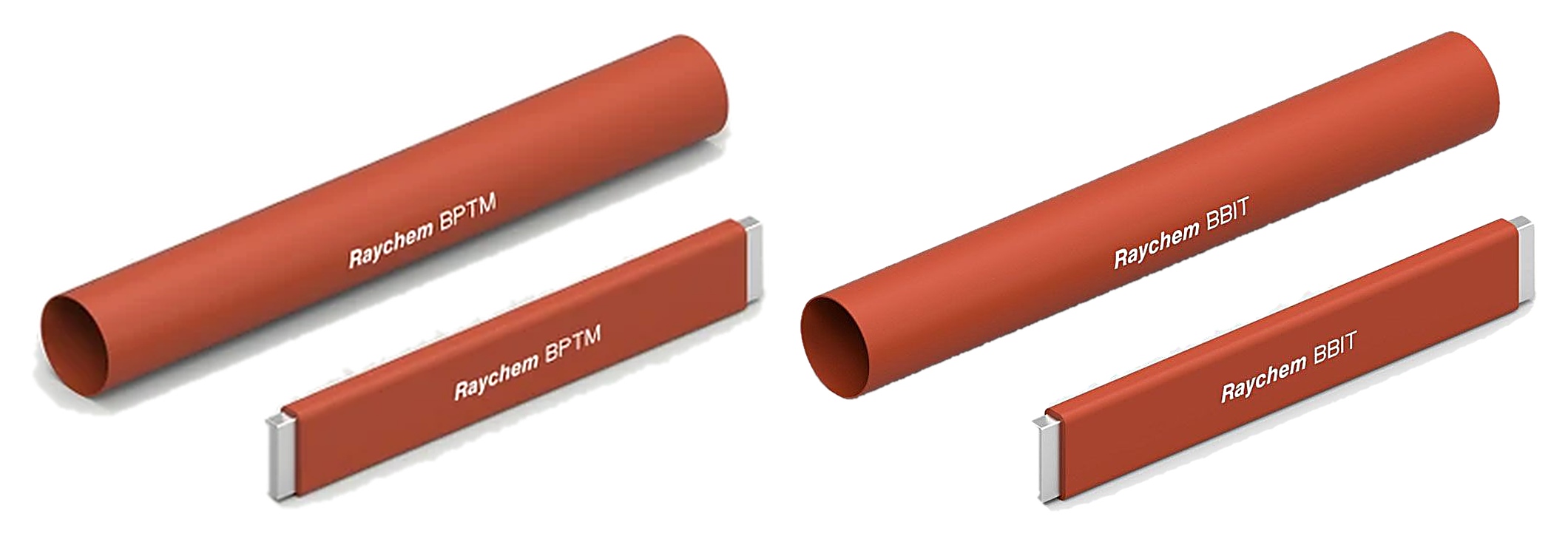
When electrical utilities and switchgear manufacturers need to improve busbar insulation, reduce electrical clearances, and protect energized equipment, TE Connectivity's Raychem busbar insulation tubing offers a practical solution. Two commonly used options are Raychem BBIT heavy-wall insulation tubing and Raychem BPTM medium-wall insulation tubing.
Although both products are heat-shrinkable tubing designed to insulate copper and aluminum busbars, they differ in wall construction, voltage class, and application requirements.
The primary difference is that BBIT is heavy-wall tubing designed for applications requiring greater clearance reduction or insulation up to 36 kV, while BPTM is medium-wall tubing designed for applications requiring some clearance reduction or insulation up to 25 kV. The appropriate choice depends on the electrical system, busbar dimensions, and insulation requirements.
Understanding these differences helps utility engineers, electrical contractors, and switchgear manufacturers select the right Raychem product for their installation.
Raychem BBIT is heavy-wall, heat-shrinkable busbar insulation tubing manufactured by TE Connectivity. It is designed to provide insulation enhancement and protection for copper and aluminum busbars in electrical distribution and switchgear applications.
When heated during installation, BBIT shrinks around the busbar, conforming to its profile and creating a protective insulating covering.
Its heavy-wall construction makes BBIT particularly suitable for applications where greater clearance reduction or higher-voltage insulation capability is required.
BBIT is commonly considered for switchgear, substations, and other electrical equipment where busbar insulation and space constraints are important design considerations.
Raychem BPTM is medium-wall, heat-shrinkable busbar insulation tubing designed to improve insulation and reduce electrical clearances in compatible electrical equipment.
Like BBIT, BPTM shrinks around the busbar when heat is applied, creating a conforming insulating layer. Its medium-wall construction makes it suitable for applications where the required insulation performance and clearance reduction can be achieved without using heavy-wall tubing.
TE Connectivity identifies BPTM for specified applications up to 25 kV.
BPTM is a useful option for switchgear manufacturers and electrical equipment designers seeking busbar insulation where medium-wall construction meets the application's requirements.
The most important differences between Raychem BBIT and BPTM involve wall construction, voltage class, and the level of clearance reduction required.
| Feature | Raychem BBIT | Raychem BPTM |
|---|---|---|
| Full product description | Busbar insulation tubing | Busbar insulation tubing |
| Wall construction | Heavy-wall | Medium-wall |
| TE Connectivity voltage class | Up to 36 kV for specified applications | Up to 25 kV for specified applications |
| Clearance reduction | Designed for applications requiring greater clearance reduction | Designed for applications requiring some clearance reduction |
| Busbar materials | Copper and aluminum | Copper and aluminum |
| Busbar shapes | Straight or bent, subject to product suitability | Straight or bent, subject to product suitability |
| Installation method | Heat-shrink installation | Heat-shrink installation |
| Wildlife protection | Helps reduce accidental bridging risks | Helps reduce accidental bridging risks |
| Typical applications | Higher-voltage busbar insulation and demanding clearance-reduction requirements | Busbar insulation where medium-wall construction meets the design requirements |
Important: Voltage classes are product-application ratings, not a guarantee that every part number is suitable for every installation at that voltage. Always verify the current TE Connectivity product documentation and the requirements of the electrical equipment.
The most straightforward distinction between BBIT and BPTM is their wall construction.
BBIT features a heavy-wall design, while BPTM uses a medium-wall design. The difference matters when selecting insulation for an electrical assembly because the required wall thickness depends on the equipment design, voltage class, and specified performance.
A heavy-wall product may be appropriate when the application requires the characteristics of BBIT's construction. A medium-wall product may be appropriate when BPTM meets the specified insulation and clearance-reduction requirements.
Does thicker tubing automatically mean better insulation? Not necessarily. Wall thickness is only one consideration in the overall performance of a busbar insulation system. The correct product must be selected according to its voltage class, dimensions, application requirements, and compatibility with the equipment.
BBIT and BPTM should not be substituted for one another based on wall thickness alone.
Voltage class is one of the most important considerations when comparing the two products.
TE Connectivity identifies BBIT for specified applications up to 36 kV and BPTM for specified applications up to 25 kV. This distinction can help narrow the selection when designing or maintaining medium-voltage electrical equipment.
For example, an application requiring BBIT's specified 36 kV capability should not be assigned a 25 kV BPTM product simply because the tubing fits the busbar.
Likewise, a lower-voltage application does not automatically require BBIT. If BPTM meets the electrical, dimensional, and mechanical requirements, it may be the appropriate solution.
When selecting busbar insulation, confirm:
One of the main benefits of Raychem busbar insulation tubing is its ability to help equipment designers reduce air spacing between appropriately insulated conductors.
Electrical clearances are important in switchgear, substations, and distribution equipment, where multiple energized components may be located in a confined space. Applying the appropriate insulation to busbars can provide additional design flexibility and help optimize equipment layouts.
BBIT is designed for applications requiring greater clearance reduction, while BPTM is designed for applications requiring some clearance reduction.
However, installing insulating tubing does not automatically authorize a reduction in electrical clearances. Any change must be supported by the applicable equipment design, engineering requirements, and relevant standards.
Both BBIT and BPTM can help protect busbars against accidental electrical bridging caused by birds and other animals.
When an animal contacts energized and grounded components, or bridges conductors at different electrical potentials, the resulting fault can damage equipment and interrupt service. Busbar insulation can help reduce exposure to energized conductive surfaces and lower the risk of certain wildlife-related faults.
For utilities, this protection can be valuable in substations and other electrical installations where wildlife contact is a concern.
However, busbar tubing is not a complete wildlife-protection system. Its effectiveness depends on the equipment layout, the areas covered, and the specific risks present at the installation.
Yes. Both BBIT and BPTM are designed for applications involving straight or bent busbars, provided the selected tubing size and installation method are suitable for the geometry.
Their flexibility helps installers position the tubing over busbars during assembly or retrofit work. Both products can be useful in original equipment manufacturing and in retrofit applications where access to one end of the busbar allows the tubing to be installed.
Before selecting a product, consider the busbar's width, thickness, shape, bends, and overall dimensions. The selected tubing must recover properly around the entire covered section.
Always follow TE Connectivity's instructions for surface preparation, heating, and installation.
The right product depends on the electrical and physical requirements of the installation.
Neither product is universally better. BBIT and BPTM serve different design requirements, and the correct choice should be based on the complete application rather than wall thickness alone.
No, BBIT and BPTM should not be considered automatically interchangeable.
Although both are Raychem heat-shrinkable busbar insulation products, their wall construction and specified voltage classes differ.
Before replacing one with the other, verify the following:
A product that fits physically is not necessarily an approved or technically equivalent replacement.
If you are replacing an existing BBIT or BPTM part number, use TE Connectivity's product documentation to verify the exact specifications before ordering.
Choosing the correct Raychem busbar insulation tubing starts with understanding the electrical and physical requirements of the application.
Before ordering, identify:
TE Connectivity provides product selection information and dimensional tables to help identify appropriate tubing sizes. Always consult the current product documentation before finalizing a selection.
Learn how to install heat shrinkable busbar insulating tubing on both circular and rectangular copper or aluminum busbars. Always follow the instructions supplied with the product.
Powertech Associates and Utility Power Supply Company support electric utilities, electrical contractors, and switchgear manufacturers with products and solutions for electrical distribution systems.
Browse our online store for Raychem BBIT Heavy-Wall Busbar Insulation Tubing and Raychem BPTM Medium-Wall Busbar Insulation Tubing.
Selecting the right part number is essential to ensure compatibility with your busbar dimensions and electrical application. Having the existing part number, busbar dimensions, and system voltage available can help narrow the options and simplify product selection.
For assistance identifying the correct TE Connectivity Raychem busbar insulation tubing, contact Powertech Associates.
BBIT is heavy-wall Raychem busbar insulation tubing designed for specified applications up to 36 kV. BPTM is medium-wall tubing designed for specified applications up to 25 kV. BBIT is intended for applications requiring greater clearance reduction or higher-voltage insulation capability, while BPTM is suitable where its medium-wall construction meets the design requirements.
TE Connectivity identifies BBIT for specified busbar insulation applications up to 36 kV. Confirm the exact part number and its suitability for the intended installation.
TE Connectivity identifies BPTM for specified busbar insulation applications up to 25 kV. The appropriate product must be selected according to the system voltage and equipment design.
Yes. Both product families are designed for copper and aluminum busbars. The correct tubing size must be selected according to the busbar's dimensions and shape.
Yes. Both can help reduce air spacing between appropriately insulated busbars when the application and equipment design permit it. BBIT is designed for applications requiring greater clearance reduction, while BPTM is designed for applications requiring some clearance reduction.
Both can help reduce the risk of accidental bridging caused by birds and other animals. They should be considered part of an appropriate insulation and wildlife-protection strategy rather than a complete solution on their own.
Start with the busbar material, shape, dimensions, and system voltage. Then consult TE Connectivity's selection tables to identify the correct tubing size and confirm its suitability for the application.
No. BBIT offers heavy-wall construction and a higher specified voltage class, but BPTM may be entirely appropriate when medium-wall tubing meets the application's electrical and dimensional requirements. The correct product is the one that meets the equipment design and manufacturer specifications.
