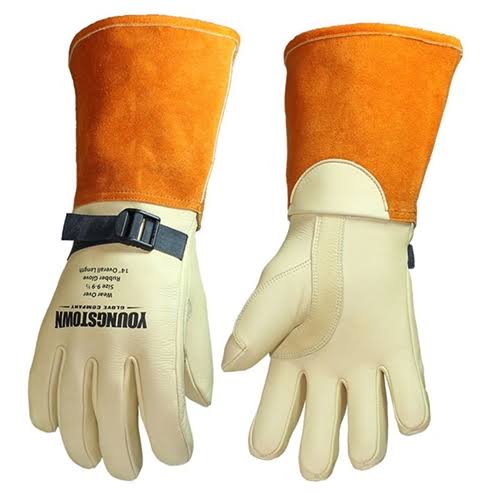
A rubber insulating glove is the part that protects a lineworker from voltage, and it is also the part that gets cut, punctured and scuffed. A leather protector goes over the rubber glove to take that mechanical abuse and add arc protection. Youngstown makes protectors in several styles and lengths, and picking the right one comes down to your rubber glove class, the job, and how much dexterity and cut protection the crew needs.
A leather protector is an outer glove worn over a rubber insulating glove. It protects the rubber from cuts, punctures, abrasion and arc flash, and ASTM F696 is the standard that covers protectors for rubber insulating gloves and mittens. Protectors are used for mechanical protection only. Youngstown is clear on every listing: leather protectors do not protect against shock or voltage. The rubber glove does that.
Youngstown splits its protectors into two groups based on the class of rubber glove they fit over.
| Type | Fits Over | Leather | Arc Rating | Puncture |
|---|---|---|---|---|
| Primary | Class 1 through 4 rubber gloves | Premium cow grain with cow suede cuff | 32 cal/cm² | ANSI/ISEA 105 Level 5 |
| Secondary | Class 0 and 00 rubber gloves | Goat grain | 25 cal/cm² | ANSI/ISEA 105 Level 3 |
Arc ratings are per ASTM F2675. Both are built with an FR strap system, so nothing on the protector will drip, melt or ignite if exposed to sparks or flames, and both are listed as compliant with NFPA 70E and OSHA 29 CFR Part 1926. The glove is double stitched with Coats thread, and the cuff on cuffed styles is double stitched with Kevlar fiber.
Both use an ergonomic 3D pattern, which is meant to fit over a rubber glove without the bulk and stiffness of older protector designs.
The protector has to match the rubber glove, so start with the class marked on the glove. Maximum use voltage by class (AC, per ASTM D120):
| Class | Max Use Voltage (AC) | Youngstown Protector Group |
|---|---|---|
| 00 | 500 V | Secondary |
| 0 | 1,000 V | Secondary |
| 1 | 7,500 V | Primary |
| 2 | 17,000 V | Primary |
| 3 | 26,500 V | Primary |
| 4 | 36,000 V | Primary |
The standard protector for utility crews working on distribution and transmission lines. It comes in several lengths so the cuff covers the cuff of the rubber glove: 12 in, 13 in, 14 in, 15 in and 16 in. Match the protector length to the length of the rubber glove you are wearing.
For lower voltage work where dexterity matters more. The goat grain leather is water resistant and softer than cow, which helps when crews are working in wet or rainy conditions. Available as a 10 in and a 13 in model. The 13 in model adds a cow suede cuff.
When the work involves sharp edges, hardware or cutting hazards, the Kevlar lined protector adds a layer of DuPont Kevlar fiber through the entire glove and cuff. On the 14 in Class 1 to 4 model, Youngstown lists:
The Kevlar lined protectors are stocked in 10 in, 12 in, 13 in and 14 in lengths. Check the glove class on the product page for each length.
The contour cuff is a sculpted cow suede cuff that sits closer to the arm for a more natural fit. It has the same 32 cal/cm² arc rating and Level 5 puncture resistance as the standard primary protector, and the cuff is double stitched with Kevlar fiber. It is available in 14 in and 16 in.
For crews using rubber insulating mittens, the 14 in Primary Leather Protector Mitt fits over Class 1 to 4 rubber mittens. It has the same 32 cal/cm² arc rating, Level 5 puncture resistance, extended cuff and water-resistant cow grain leather as the primary glove style.
Expertex is Youngstown's hybrid protector, built to ASTM F3258. That standard opened the protector category to materials other than leather, as long as they meet its safety criteria. The result is a lighter, more flexible protector.
The 10 in Secondary Expertex Hybrid is made for Class 0 and 00 rubber gloves. It uses a Hi-Viz FR Nomex knit on the top of the hand and a 0.6 mm sheep grain leather palm that keeps a near second skin feel while still giving abrasion resistance and grip. It is a good fit for jobs that need the most dexterity possible.
Inspect protectors before each use for cuts, burns, holes, worn stitching and damaged straps, and replace any that are damaged. Protectors are used for mechanical protection only, so the rubber glove underneath still has to be inspected and tested on its own schedule. Follow your company's safety program and the manufacturer's instructions.
No. Youngstown states that its leather protectors do not protect against shock or voltage. They protect the rubber insulating glove from mechanical damage and add arc protection. The rubber glove provides the electrical protection.
A primary protector fits over Class 1 to 4 rubber gloves and uses cow grain leather with a 32 cal/cm² arc rating. A secondary protector fits over Class 0 and 00 gloves, uses goat grain leather, and is rated 25 cal/cm².
ASTM F696 is the standard specification for leather protectors for rubber insulating gloves and mittens. Youngstown designs its leather protectors for use over rubber insulating gloves per this standard.
Match it to the length of your rubber glove. Primary protectors come in 12, 13, 14, 15 and 16 in lengths, and secondary protectors in 10 and 13 in.
A protector with a layer of DuPont Kevlar fiber through the glove and cuff for added cut, puncture and flame resistance. The 14 in Class 1 to 4 model is arc rated to 48 cal/cm² and cut rated to ANSI/ISEA 105 Level A3.
A protector built to ASTM F3258 that combines modern materials with a leather palm. The 10 in secondary uses a Hi-Viz FR Nomex top of hand and a 0.6 mm sheep grain palm for high dexterity over Class 0 and 00 gloves.
Yes. The 14 in Primary Leather Protector Mitt fits over Class 1 to 4 rubber mittens.
They use an FR strap system, and Youngstown states the protector will not drip, melt or ignite if exposed to sparks or flames. Arc ratings run from 25 to 48 cal/cm² depending on the style.
Powertech Associates supplies Youngstown gloves and protectors to electric utilities, line contractors and municipal crews. You can shop Youngstown leather protectors online. To confirm the right protector for your rubber glove class, check sizes and availability, or order for a crew, contact Powertech Associates.
Learn more on the manufacturer's page: Youngstown Glove leather protectors.
