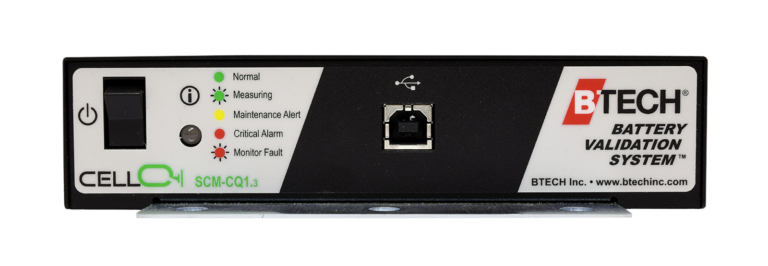
The BTECH CellQ1 is a battery monitoring system for smaller battery systems. It measures unit voltage, impedance and temperature, plus string voltage and current, and sends the data and alarms to BTECH's BVM software, so a weak battery shows up without a technician visiting the site.
BTECH lists station batteries and switchgear among its uses, along with gensets, telecom, UPS systems, emergency lighting and PBX. For a utility, that makes it a fit for smaller DC plants and remote sites where a larger system would be more than you need. This guide covers what it measures, how big a system it handles, and what to gather before you ask about it.
BTECH's sell sheet lists these records and trends:
Data can be viewed in real time with BTECH's BVM software. BTECH says the system gives advance notice of potential failures through real-time monitoring and data collection, and supports remote analysis and troubleshooting.
| Item | CellQ1 |
|---|---|
| Battery types | Vented lead-acid and valve-regulated |
| Locations | 2 locations. One controller can measure 2 independent battery systems |
| Units per string | 2 to 24 |
| Unit voltages | 2, 4, 6, 8, 12 and 16 V units |
| System voltage | 2 to 125 V |
| Modules | Up to 48 per location |
| Ambient temperature | 1 input |
| Controller | SCM-CQ1.3 |
| Current module | BVi3, for string current |
| Unit module | VTz3H/L, one per unit, measures voltage, temperature and impedance |
| Communications | Integrated network card (RJ-45), Modbus over TCP/IP, SNMP traps. Optional wireless router on a private network |
| Ports and contacts | Local USB port, 2 NC auxiliary alarm output contacts, 2 auxiliary input contacts |
| Input power | 100 to 240 VAC, 50/60 Hz, 25 W, or 12 to 48 VDC, 5 W operating |
| Operating temperature | -5 to 75 °C (23 to 167 °F) |
| Mounting | Flush mount or DIN rail mount |
BTECH says the CellQ1 uses the same software as its S5 Battery Monitoring System:
If you run several BTECH systems across sites, the BVM Enterprise Toolkit pulls them into one view.
BTECH's brochure positions the S5 as its premier system for large critical backup plants, handling up to 480 cells across eight strings. The CellQ1 is the scalable option for smaller systems, with 2 to 24 units per string and two locations per controller. For substation-size plants with many cells and strings, see the BTECH S5 guide.
BTECH's CellQ1 materials do not make a NERC PRC-005 claim. If you are weighing it for a compliance program, confirm with BTECH and your compliance group which checks its data can support.
A BTECH battery monitoring system for smaller battery systems, measuring unit voltage, impedance and temperature along with string and system data.
2 to 24 units per string, with up to 48 modules per location and two locations per controller.
Vented lead-acid and valve-regulated batteries.
2, 4, 6, 8, 12 and 16 V units, and 2 to 125 V systems.
Through its network card using Modbus over TCP/IP and SNMP traps, and through two NC auxiliary alarm output contacts. A wireless router on a private network is optional.
Yes. BTECH says both use BVM, BVS Observer, BVM Status Monitor and OBVM.
BTECH lists station batteries and switchgear among its applications, aimed at small systems. For larger plants, ask BTECH whether the S5 is the better fit.
For questions or a quote, contact Powertech Associates and UPSC at info@powertech-upsc.com or (860) 678-8772. Send us your battery type, number of units and strings, and how you want alarms delivered.
